


 (+86)-137 5851 1881
(+86)-137 5851 1881
(+86)-137 5851 1881



Content
Slack adjusters are mechanical levers that connect the brake chamber push rod to the S-cam shaft in air-actuated drum brake systems on commercial trucks, trailers, and buses. Their single most important job is to maintain the correct clearance between the brake lining and the brake drum — a gap typically held between 0.010 and 0.020 inches (0.25–0.51 mm) at rest. As brake linings wear thinner over tens of thousands of kilometers, that gap grows. The slack adjuster compensates, either through manual readjustment by a technician or, in modern automatic designs, through a built-in clutch-and-worm mechanism that self-corrects during every brake application. A properly functioning slack adjuster keeps push rod stroke within the legal maximum, preserves braking force, and prevents the vehicle from failing roadside inspection. A neglected or failed one is a direct safety hazard — and one of the most commonly cited brake violation categories in commercial vehicle enforcement.
To understand what a slack adjuster does, it helps to trace the braking sequence from driver input to wheel stop. When the driver presses the brake pedal, the foot valve meters compressed air from the reservoir into the brake chambers at each axle end. Inside the chamber, air pressure pushes against a flexible diaphragm, driving the push rod outward in a straight line. That linear force has to be converted into the rotational torque needed to turn the S-cam, which in turn spreads the brake shoes against the drum — and that conversion is exactly what the slack adjuster performs.
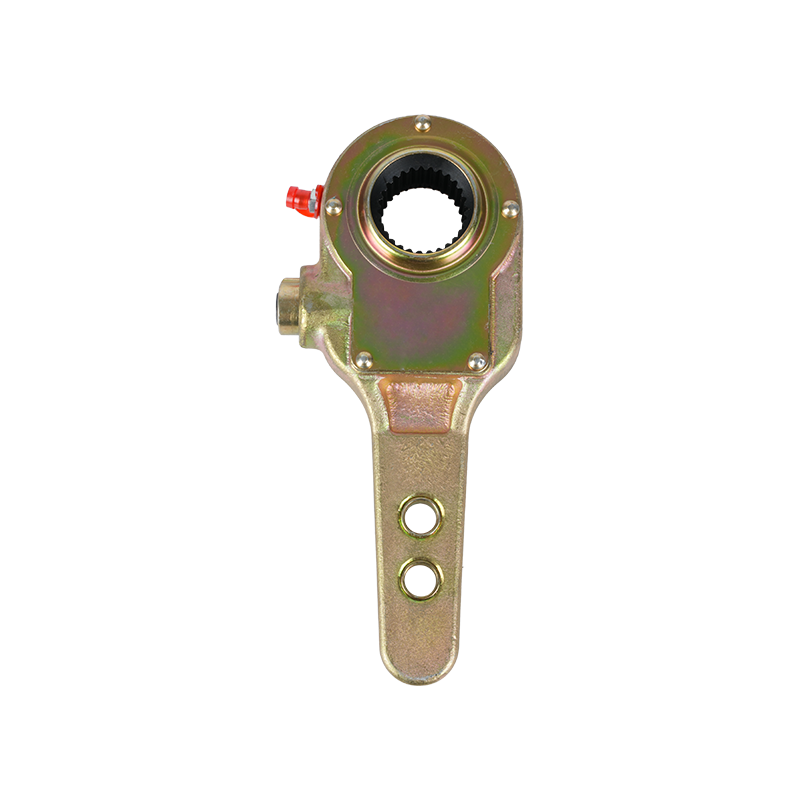
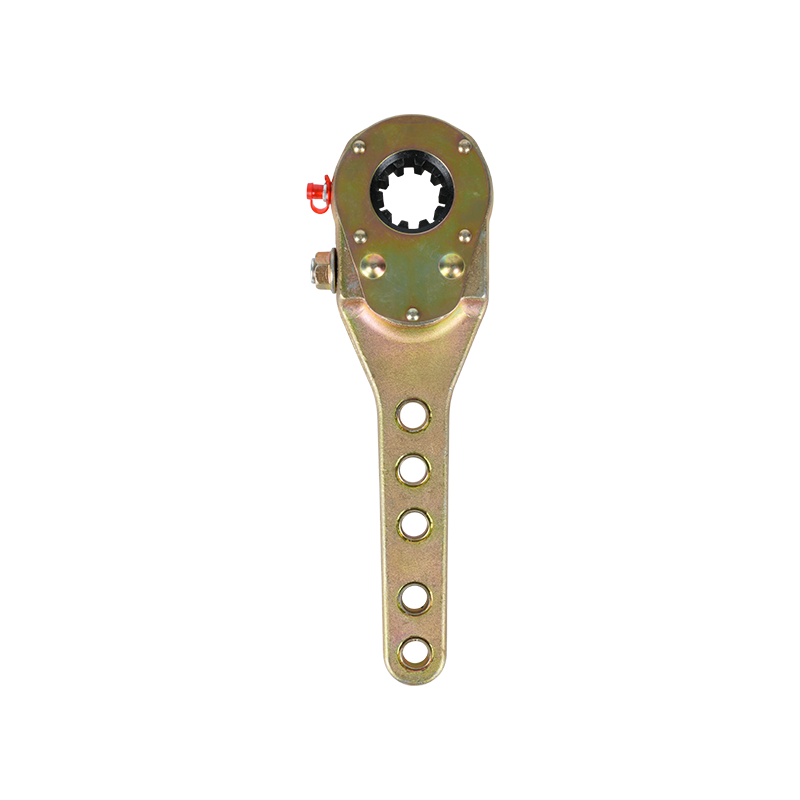
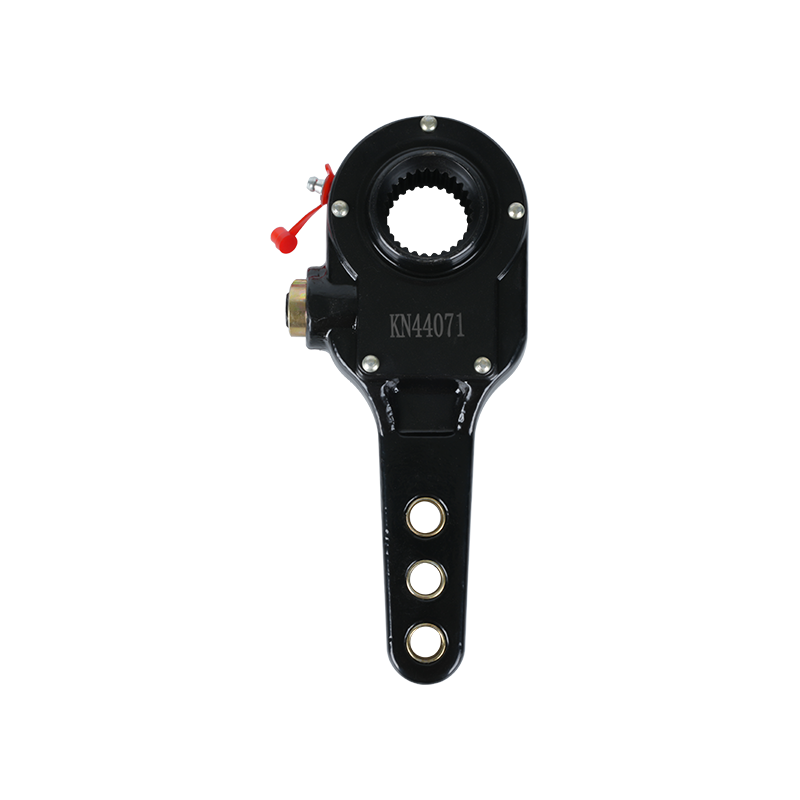
Mechanically, the slack adjuster is a lever arm. One end pivots on the S-cam shaft via a splined bore; the other end connects to the push rod via a clevis pin. The arm length — measured from the center of the camshaft bore to the center of the clevis pin hole — determines the mechanical advantage applied. Most heavy-vehicle slack adjusters use an arm length of 5 to 6 inches (127 to 152 mm). A longer arm produces greater torque but requires more push rod travel; a shorter arm needs less stroke but generates less turning force. Selecting the correct arm length for the axle position is therefore a critical fitment decision, not a cosmetic one.
Slack adjusters used in commercial vehicle air brake systems fall into three categories. Each has a distinct internal mechanism, a different maintenance demand, and a specific range of applications where it excels.
The manual type is the original design. A hexagonal adjustment bolt on the side of the housing connects to an internal worm gear. Rotating the bolt clockwise turns the worm, which advances the S-cam shaft and tightens the lining-to-drum clearance. Adjustment must be performed by a technician at every preventive maintenance interval — typically every 25,000 km or as specified by the vehicle manufacturer. If adjustment is skipped, push rod travel creeps past the legal maximum stroke limit, reducing brake effectiveness and triggering an out-of-service order at inspection. Manual adjusters remain in use on older fleet vehicles and in markets where service intervals are tightly controlled.
Automatic slack adjusters (ASAs) incorporate a one-way clutch mechanism that detects excess push rod travel and self-adjusts during each normal brake application. When the push rod extends further than the preset threshold, the internal clutch engages and rotates the worm gear by a small increment, reducing clearance. On release, a spring-loaded pawl holds the new position. Because adjustment is continuous and automatic, push rod stroke stays within specification throughout the service life of the brake lining — provided the foundation brake components (drum, lining, camshaft bushings) are also in good condition. Automatic adjusters are now mandated on new air-braked commercial vehicles in most major markets.
The double spring slack adjuster is an advanced variant of the automatic design that incorporates two springs in its internal adjustment mechanism: a primary drive spring that powers the adjusting movement and a secondary return spring that firmly holds the worm gear in its adjusted position after brake release. This dual-spring architecture addresses the most common failure mode of single-spring automatics — back-adjustment, where vibration or rapid brake cycling causes the worm to drift backward, gradually increasing push rod travel between adjustment events. By adding a second spring to lock the adjusted position, the double spring design delivers more consistent lining-to-drum clearance across the full service cycle, making it particularly well suited to high-vibration environments such as off-highway construction, mining haul roads, refuse collection routes, and heavy port tractor applications where conventional automatic adjusters may struggle to maintain stable adjustment.
| Comparison of the three main slack adjuster types across key operational characteristics | |||
| Characteristic | Manual | Automatic (Single Spring) | Double Spring Automatic |
| Adjustment trigger | Technician with wrench | Automatic per brake application | Automatic per brake application |
| Back-adjustment risk | None (fixed position) | Moderate under vibration | Low (dual spring locks position) |
| Service interval demand | High — every PM check | Low — inspect only | Low — inspect only |
| Vibration tolerance | Good | Moderate | Excellent |
| Typical application | Older fleets, legacy equipment | Standard on-highway trucks | Off-road, mining, heavy haul |
In standard highway operation, a conventional single-spring automatic slack adjuster performs reliably. Brake applications are predictable, vibration levels are moderate, and the lining wears at a steady rate. However, heavy-duty operating environments introduce conditions that challenge the single-spring design in three specific ways.
Off-road and mining vehicles traverse surfaces that transmit constant vibration directly into the brake assembly. Under these conditions, the single return spring in a conventional automatic adjuster may allow the worm gear to ratchet backward incrementally with each vibration cycle. Over time, the cumulative effect increases push rod travel and degrades braking performance — often without triggering an obvious inspection failure until the situation is severe. The double spring slack adjuster's secondary locking spring prevents this backward migration, keeping adjustment stable regardless of road surface quality.
Applications such as refuse collection, urban delivery, or port terminal tractors involve extremely high brake cycle counts — sometimes hundreds of full brake applications per hour. Each release event puts stress on the internal clutch mechanism. A double spring design distributes the return load across two springs rather than one, reducing the stress concentration on individual components and extending the operational life of the adjustment mechanism between overhaul intervals.
Heavier loads mean greater braking torque demands, which translate into higher forces through the slack adjuster arm and clevis pin connection. A double spring slack adjuster engineered for heavy-duty gross weights uses larger-diameter spring wire and a reinforced housing to handle these elevated loads without deforming or losing adjustment accuracy. Selecting an adjuster rated for the actual operating gross weight — not just the minimum legal requirement — is a key factor in achieving full lining service life.
Slack adjuster inspection is required as part of pre-trip checks and is a primary focus area during roadside commercial vehicle enforcement. The following procedure applies to both manual and automatic types, including double spring slack adjusters.
Correct installation determines whether a slack adjuster — particularly an automatic or double spring type — will function as designed throughout its service life. The three most common installation errors are incorrect arm length, wrong camshaft spline engagement, and failure to set the initial adjustment before relying on the automatic mechanism.
The slack adjuster's internal bore must match the S-cam shaft in both spline count and diameter. Common spline specifications for heavy trucks include 10-spline and 28-spline configurations in shaft diameters ranging from 1.0 inch to 1.5 inches (25.4 to 38.1 mm). Installing a mismatched adjuster will either prevent assembly entirely or allow the spline to strip under braking load. Always confirm the shaft specification from the axle manufacturer's data before ordering a replacement.
When the brakes are fully released, the slack adjuster arm should be positioned approximately perpendicular to the push rod centerline — typically within a window of 85° to 95°. This geometry maximizes the effective mechanical advantage through the full range of push rod travel. Mounting the adjuster outside this angular range reduces braking efficiency and causes uneven lining wear, even if all other specifications are correct.
Even on automatic and double spring slack adjusters, an initial manual adjustment is required at installation to establish the starting clearance. Tighten the adjustment bolt until the lining just contacts the drum, then back off the specified amount — typically one-quarter to one-half turn — to establish running clearance. After initial setup, pump the brakes several times to allow the automatic mechanism to cycle, then re-measure push rod stroke to confirm it is within the permitted maximum. Lubricate all grease fittings — usually two on the adjuster body and one at the clevis pin — with NLGI Grade 2 chassis grease at installation and at every PM service thereafter. Blocked or missing grease fittings must be replaced immediately; a dry worm gear will seize and the adjuster will lose its ability to self-correct.
Recognizing early warning signs prevents roadside failures and keeps brake performance consistent across the full axle set. The following symptoms indicate that inspection or replacement is required.
Push rod travel that exceeds the maximum stroke limit for the chamber type is the primary indicator that the slack adjuster is not maintaining correct adjustment. On automatic and double spring types, this usually means the foundation brake needs attention first — but it can also indicate a seized or worn-out adjuster mechanism that is no longer capable of self-correcting.
If one side of an axle is correctly adjusted and the other is under-adjusted, the tighter side applies braking force sooner and harder, pulling the vehicle toward that wheel. Unequal adjustment across a drive axle is a common cause of unexpected steering behaviour under emergency braking and can also cause rapid, uneven lining wear.
An adjuster set too tightly — or one with a seized return mechanism — holds the cam partially rotated even after air pressure is released, keeping the lining in contact with the drum. This generates heat, accelerates lining wear, causes hub temperature to rise, and can lead to brake fire in severe cases. A wheel that is noticeably hotter than its pair after a drive is a reliable indicator of brake drag.
A failed internal seal allows lubricant to escape from the worm gear housing. Once the grease is lost, the internal mechanism runs dry, friction increases dramatically, and the adjustment function degrades within a short operating period. Any visible grease trail on the adjuster housing or surrounding components should prompt immediate inspection and seal replacement.
The clevis pin connecting the push rod to the slack adjuster arm should have minimal free movement. If the pin bore in the arm has worn oval, or if the pin itself is undersize due to wear, the lost motion reduces the effective push rod stroke — meaning the brakes do not fully apply despite the push rod appearing to travel the correct distance. Replacing the pin and bushing restores full mechanical contact.
A double spring slack adjuster is built for durability, but its service life is directly tied to the quality of the surrounding brake system and the consistency of preventive maintenance. The following practices protect the investment in high-specification adjusters and keep braking performance at its peak.


 English
 中文简体
中文简体 русский
 عربى
عربى