


 (+86)-137 5851 1881
(+86)-137 5851 1881
(+86)-137 5851 1881



Content
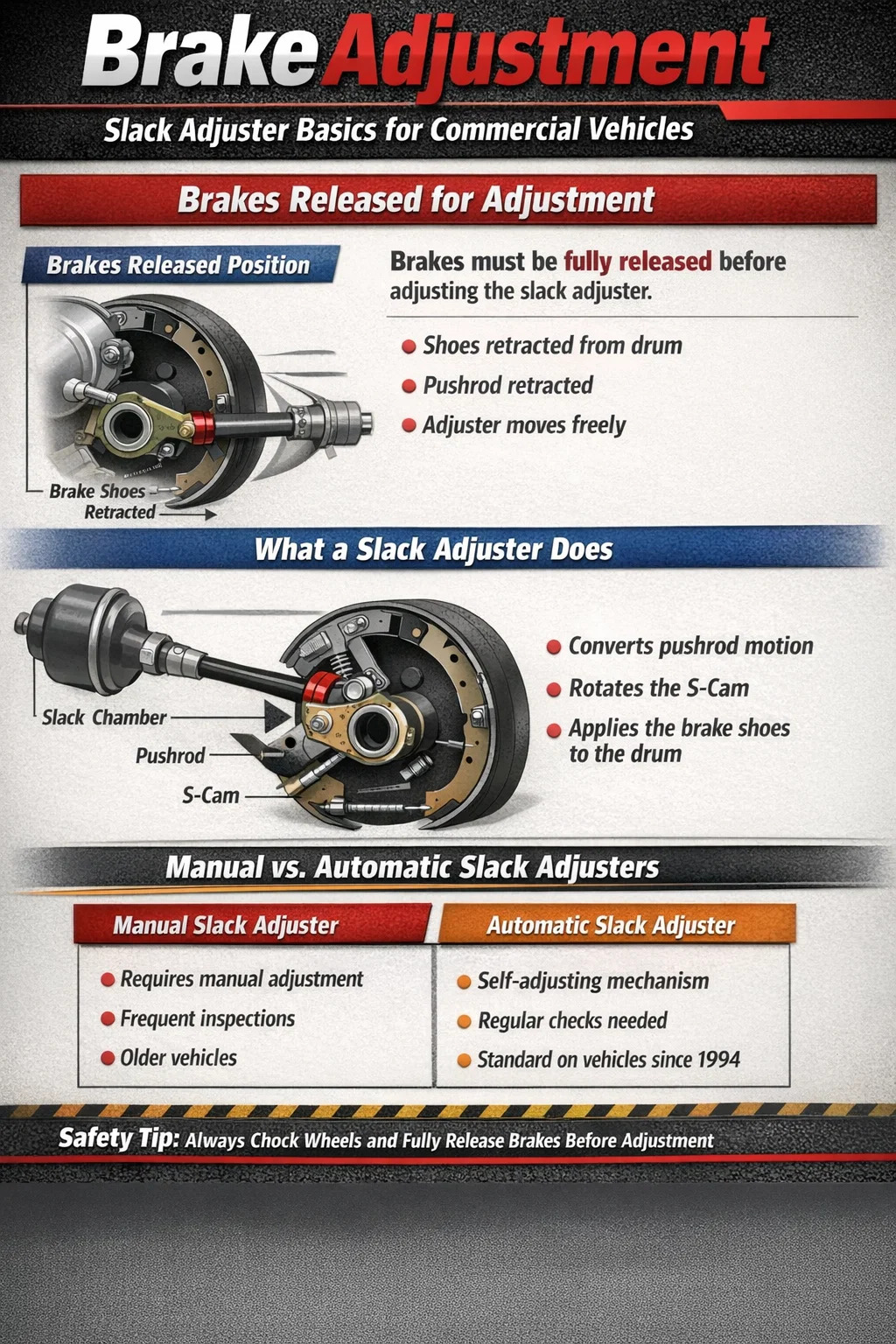
When adjusting a slack adjuster, the brakes must be fully released. This is the correct procedure for both manual slack adjusters and the initial setup of automatic slack adjusters. With the brakes released, the brake shoes are retracted away from the drum, allowing the adjuster to move the pushrod and camshaft freely without binding or creating false readings. Attempting to adjust with the brakes applied introduces spring tension and friction that masks the true slack in the system, resulting in an improperly adjusted brake that can either drag or fail to engage with enough force.
This rule applies across air brake systems on commercial trucks, trailers, and buses — any vehicle governed by FMCSA regulations under 49 CFR Part 393. Brake adjustment affects stopping distance directly. A brake that is out of adjustment by even a fraction of an inch in pushrod travel can reduce braking effectiveness significantly, especially during emergency stops when consistent brake timing across all axles is critical.
Understanding why brakes must be released — not just that they must be — helps technicians avoid common errors and ensures repeatable results across different vehicles and brake configurations.
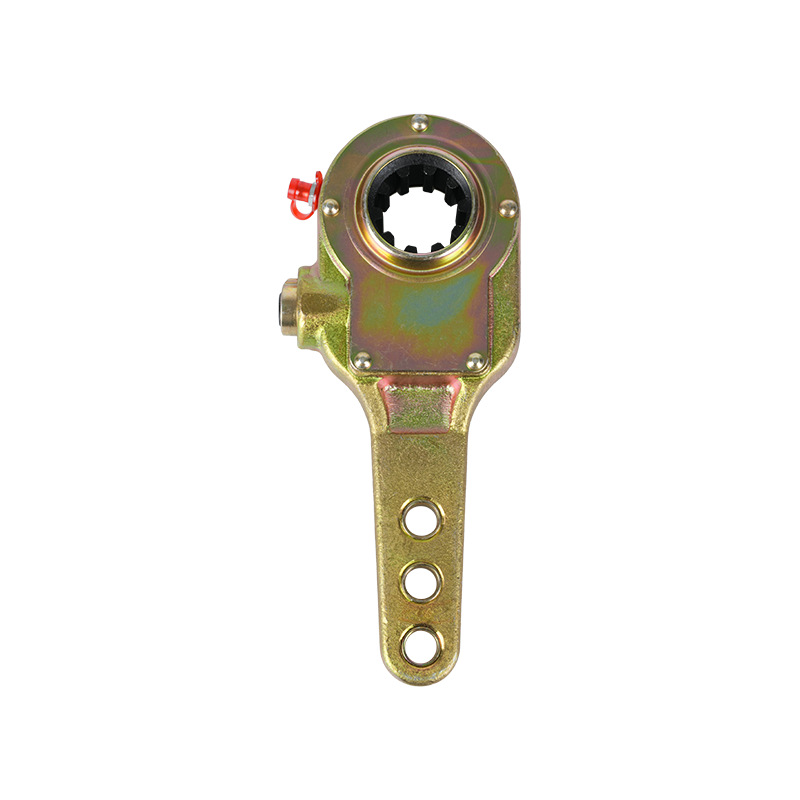
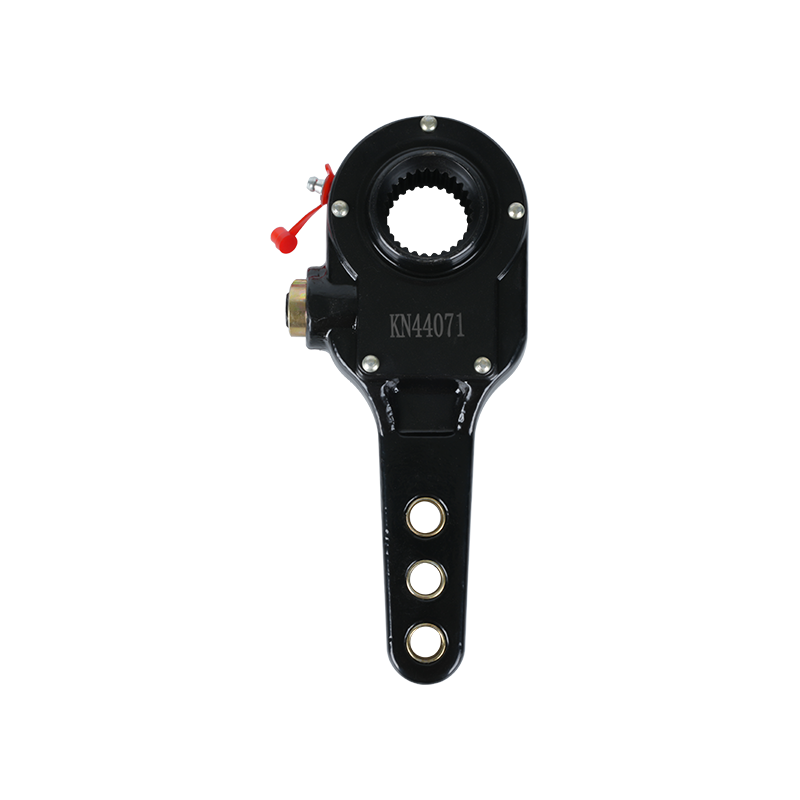
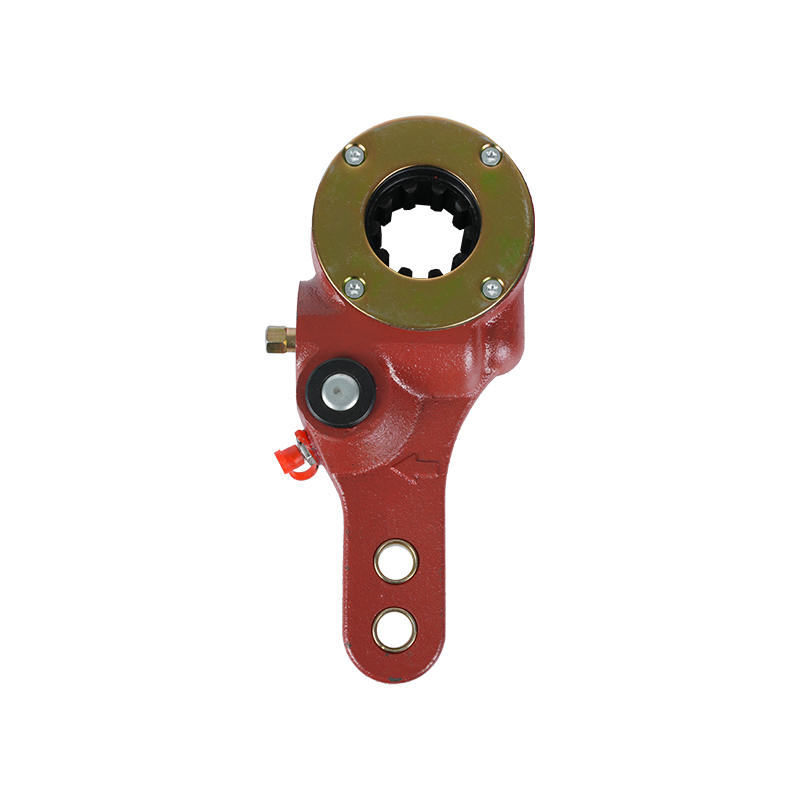
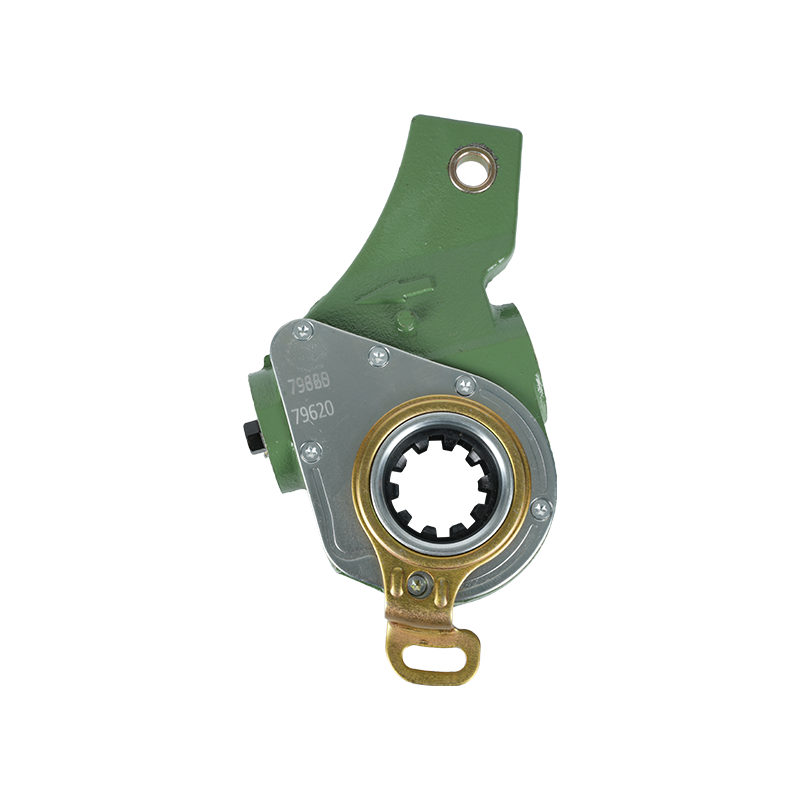
A slack adjuster is a lever arm that connects the brake chamber pushrod to the brake camshaft. Its primary function is to convert the linear motion of the pushrod into rotational force on the S-cam, which in turn pushes the brake shoes outward against the drum. The "slack" it manages refers to the free travel in the system — the gap between the brake shoes and the drum surface when the brakes are not applied.
As brake linings wear down over time, the distance between the shoe and drum increases. If the slack adjuster is not adjusted to compensate, the pushrod must travel farther before the brakes engage, which delays brake response and reduces clamping force. This is why regular inspection and adjustment are mandatory under federal and state commercial vehicle regulations.
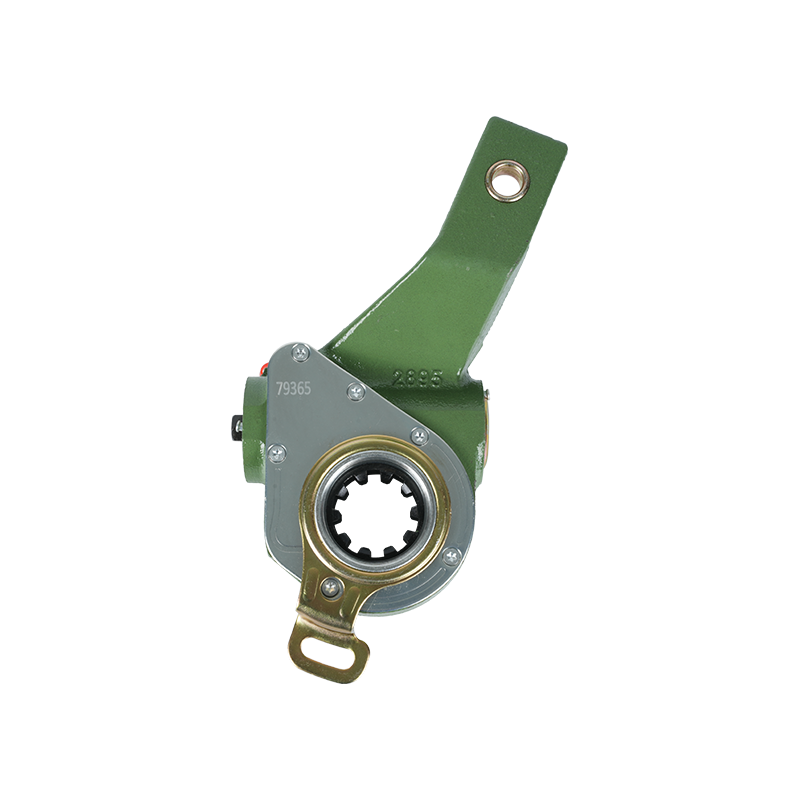
There are two types of slack adjusters in common use:
Both types share the same fundamental geometry and leverage principles, which is why the adjustment procedure — brakes released, correct pushrod angle, proper torque — applies to both.
The mechanical reason brakes must be released during slack adjuster adjustment comes down to resistance and geometry. When the brakes are applied, the brake chamber is pressurized and the pushrod is extended. The S-cam has rotated, forcing the brake shoes firmly against the drum with significant force — often several thousand pounds of clamping load. In this state:
With brakes fully released and air pressure bled from the chamber, the pushrod is retracted, the S-cam is in its rest position, and the brake shoes are held away from the drum by the return springs. The adjuster worm gear turns freely, and any rotation of the adjuster directly corresponds to a change in the at-rest pushrod stroke length. This is the only condition under which an accurate, repeatable adjustment can be made.
For safety during adjustment, always chock the wheels and ensure the parking brake is released from the specific axle being worked on. On vehicles with spring-applied parking brakes (common on drive axles), the parking brake holds the brakes applied mechanically — this must be released before adjusting the service brake slack adjusters on that axle.
Manual slack adjuster adjustment is a straightforward procedure when done correctly. The following steps apply to S-cam drum brake systems, which remain the most common configuration on North American commercial vehicles.
The wheel spin check at the end of the procedure is critical. A drum that does not spin freely indicates the shoes are dragging against the drum, which will cause overheating, accelerated lining wear, and potential brake fade during vehicle operation.
Federal regulations under 49 CFR 393.47 specify maximum allowable pushrod stroke for each brake chamber size. Exceeding these limits at inspection is a violation that can result in the vehicle being placed out of service. The following table lists the most common chamber sizes and their maximum stroke limits:
| Chamber Type | Chamber Size | Max Stroke (inches) | Typical Application |
|---|---|---|---|
| Standard | Type 16 | 1.75 | Steer axle on lighter trucks |
| Standard | Type 20 | 1.75 | Steer axle on medium trucks |
| Standard | Type 24 | 2.00 | Drive axle, common on Class 8 |
| Standard | Type 30 | 2.00 | Drive axle on heavy-duty trucks |
| Long Stroke | Type 24 LS | 2.50 | Drive axle, extended travel |
| Long Stroke | Type 30 LS | 2.50 | Heavy-duty drive/trailer axle |
| Standard | Type 36 | 2.25 | Heavy trailer axle |
Long stroke chambers are identifiable by a rectangular tag on the chamber or by a clamp ring that is longer than a standard chamber of the same size. Do not use standard stroke limits when measuring a long stroke chamber — this is a common inspection error that results in condemning a properly adjusted brake or, worse, passing one that is out of adjustment.
Automatic slack adjusters have been required on new commercial vehicles in the United States since 1994 under FMCSA regulations. Despite being called "automatic," they require correct initial installation and regular inspection. They do not eliminate the need for brake system maintenance — they replace the periodic manual turning of an adjuster bolt with an internal mechanism that compensates for lining wear incrementally during each brake application.
When installing a new automatic slack adjuster or following a brake reline, the adjuster must be manually set to establish initial clearance. This initial setup is done with brakes released, following the same logic as manual adjuster adjustment. Most manufacturers specify:
After initial setup, the automatic slack adjuster should maintain correct adjustment without further manual intervention. If pushrod stroke is consistently out of specification on a vehicle with automatic adjusters, that is a sign of a problem — not a trigger to manually adjust the adjuster as if it were a manual type.
This is one of the most important and commonly misunderstood points about automatic slack adjusters. If an automatic slack adjuster is repeatedly out of adjustment, the correct response is to find and fix the underlying cause — not to manually turn the adjuster back into spec.
Manually adjusting an automatic slack adjuster in service masks the root problem and can damage the internal clutch mechanism, causing the adjuster to over-adjust and resulting in dragging brakes. Common root causes of automatic slack adjuster failures include:
Even with brakes correctly released during adjustment, a slack adjuster that is positioned at the wrong angle will not deliver maximum braking efficiency — regardless of how precisely the pushrod stroke is set. The relationship between the pushrod and the slack adjuster arm is a critical geometry consideration that is frequently overlooked.
For maximum mechanical advantage, the slack adjuster arm should be perpendicular to the pushrod when the brakes are fully applied. At the point of full application, a 90-degree angle between the adjuster arm and pushrod produces the greatest rotational torque on the camshaft. If the arm is at 80 degrees or 100 degrees at full application, torque output drops — sometimes significantly.
In practice, achieving exactly 90 degrees at full application means the adjuster arm should be positioned slightly past 90 degrees (toward the retracted position) when brakes are released, so that as the pushrod extends during application, the arm passes through perpendicular. Many manufacturers recommend the slack adjuster arm be angled approximately 5 to 10 degrees past perpendicular in the released position as a setup guideline.
Incorrect geometry is usually caused by:
Commercial drivers operating vehicles subject to FMCSA regulations are required to conduct pre-trip inspections that include a check of brake adjustment. Under 49 CFR 392.7, the driver must be satisfied the vehicle is in safe operating condition before driving. Brake adjustment is a key part of this check.
Drivers can perform a practical check without tools using the following method:
Drivers are not expected to perform adjustments themselves during a pre-trip inspection — that is the role of a qualified mechanic. However, identifying a visually obvious out-of-adjustment condition and taking the vehicle out of service for repair before driving is both a legal obligation and a safety responsibility.
A pushrod that extends more than 2 inches on a standard Type 30 chamber is out of adjustment by federal standards and the vehicle must not be driven until corrected. This is not a recommendation — it is a violation that can result in fines, out-of-service orders, and increased liability in the event of an accident.
Even experienced technicians fall into patterns that lead to inaccurate brake adjustment. The following errors are among the most frequently observed during brake inspections and can result in brakes that pass a quick visual check but fail to perform correctly under actual operating conditions.
On spring-applied parking brake (SAPB) systems, the spring inside the parking chamber applies the brakes mechanically when air pressure is removed. Many technicians chock the wheels and release air from the parking circuit to set the spring brakes for wheel immobilization, then attempt to adjust the service brake slack adjuster on the same axle. The spring brake is applying force through the same S-cam and shoes, which means the service brake is partially or fully applied. Any adjustment made in this condition will be inaccurate.
Backing off the adjuster 1/4 turn after the shoes contact the drum is a guideline, not a guarantee. Brake geometry, drum diameter variation, lining thickness variation across the shoe, and the condition of the return springs all affect how much clearance actually results. Always spin the drum by hand after adjustment to confirm it rotates freely. A drum that requires more than light effort to turn by hand is dragging.
A Type 30 standard chamber has a maximum stroke of 2.0 inches. A Type 30 long stroke chamber has a maximum of 2.5 inches. Confusing the two is a serious error. If a standard chamber is measured against a 2.5-inch limit, a brake with 2.3 inches of stroke — which is significantly out of adjustment — will incorrectly pass inspection. Chamber identification tags should always be verified before recording stroke measurements.
Pushrod stroke must be measured with full service brake pressure applied — approximately 90 PSI at the chamber inlet. Measuring at lower pressure produces a shorter stroke reading that makes the brake appear properly adjusted when it may not be. Always use a calibrated test gauge and confirm system pressure before measuring stroke.
A slack adjuster that keeps going out of adjustment — requiring frequent readjustment — is almost always a symptom of worn foundation brake components, not a defective adjuster. Replacing the adjuster without addressing the underlying wear does not solve the problem and wastes parts and labor. Inspect the full foundation brake assembly, including the camshaft, bushings, rollers, shoes, and anchor pins, whenever a brake repeatedly goes out of adjustment.
The connection between slack adjuster adjustment and actual stopping performance is not theoretical — it is measurable and documented. Federal Motor Carrier Safety Administration brake research and CVSA inspection data consistently show that out-of-adjustment brakes are one of the leading brake-related violations found during roadside inspections, and that braking imbalance caused by adjustment variation between axles significantly increases stopping distance.
When one or more brakes on a multi-axle vehicle are out of adjustment, they engage later in the stopping event than properly adjusted brakes. The brakes that engage first carry disproportionately more of the total braking load. This leads to:
A fully loaded Class 8 truck traveling at 60 mph requires approximately 335 feet to stop under ideal conditions with all brakes properly adjusted and functioning. Studies have shown that out-of-adjustment brakes can add 20% or more to stopping distance under the same conditions — translating to an additional 67 feet or more before the vehicle comes to a stop. At highway speeds, that difference is the difference between a controlled stop and a collision.
A slack adjuster that is properly adjusted but inadequately lubricated will not maintain its adjustment or perform reliably over time. The adjuster pivot pin and internal worm gear mechanism require regular greasing. Most manufacturers specify a lithium-based or moly-based chassis grease meeting NLGI Grade 2 specifications.
Grease fittings are typically located on the body of the slack adjuster and at the clevis pin that connects the adjuster to the pushrod. Lubrication intervals vary by manufacturer but commonly fall in the range of every 25,000 to 50,000 miles for over-the-road applications, or every 3 months for vehicles operating in severe duty conditions such as construction, mining, or frequent off-road use.
Signs of inadequate lubrication include:
Automatic slack adjusters that appear seized or non-responsive to lubrication should be replaced rather than forced. Applying excessive force to a seized automatic adjuster to manually back it off can permanently damage the internal clutch, rendering the automatic function inoperative.
Understanding the differences between manual and automatic slack adjusters helps maintenance managers and owner-operators make informed decisions about brake system maintenance schedules and inspection protocols.
| Feature | Manual Slack Adjuster | Automatic Slack Adjuster |
|---|---|---|
| Adjustment method | Manual wrench turn at each service interval | Internal clutch self-adjusts with each brake application |
| Required on new vehicles since | Pre-1994 (legacy vehicles) | 1994 (FMCSA mandate) |
| In-service manual adjustment | Required and expected | Initial setup only; in-service manual adjustment indicates a problem |
| Inspection frequency | Every PM or mileage interval | Regular inspection to verify auto function |
| Primary failure mode | Lining wear between adjustments | Worn foundation components, seized mechanism |
| Cost | Lower part cost | Higher part cost, lower labor cost over time |
| Adjustment brakes position | Always released | Released for initial setup |
Brake adjustment compliance is enforced through two primary channels: FMCSA roadside inspections conducted by enforcement officers and periodic vehicle inspections required by state regulations. Understanding what inspectors look for helps maintenance operations stay consistently compliant.
The Commercial Vehicle Safety Alliance (CVSA) North American Standard Out-of-Service Criteria define the conditions under which a vehicle must be placed out of service immediately for brake violations. For slack adjuster issues, the relevant criteria include:
CVSA Brake Safety Week data from recent years consistently shows that brake adjustment violations — including out-of-adjustment slack adjusters — account for a significant share of all brake-related out-of-service orders. In 2022, brake adjustment violations were among the top five violations found during targeted brake inspections, affecting a measurable percentage of inspected commercial vehicles.
Maintaining proper brake adjustment is not only a safety imperative — it is a compliance requirement with direct financial and operational consequences when ignored. A single out-of-service order can delay a load, trigger increased inspection scrutiny, and affect a carrier's CSA score, which influences insurance rates and eligibility for certain contracts.


 English
 中文简体
中文简体 русский
 عربى
عربى