


 (+86)-137 5851 1881
(+86)-137 5851 1881
(+86)-137 5851 1881



Content
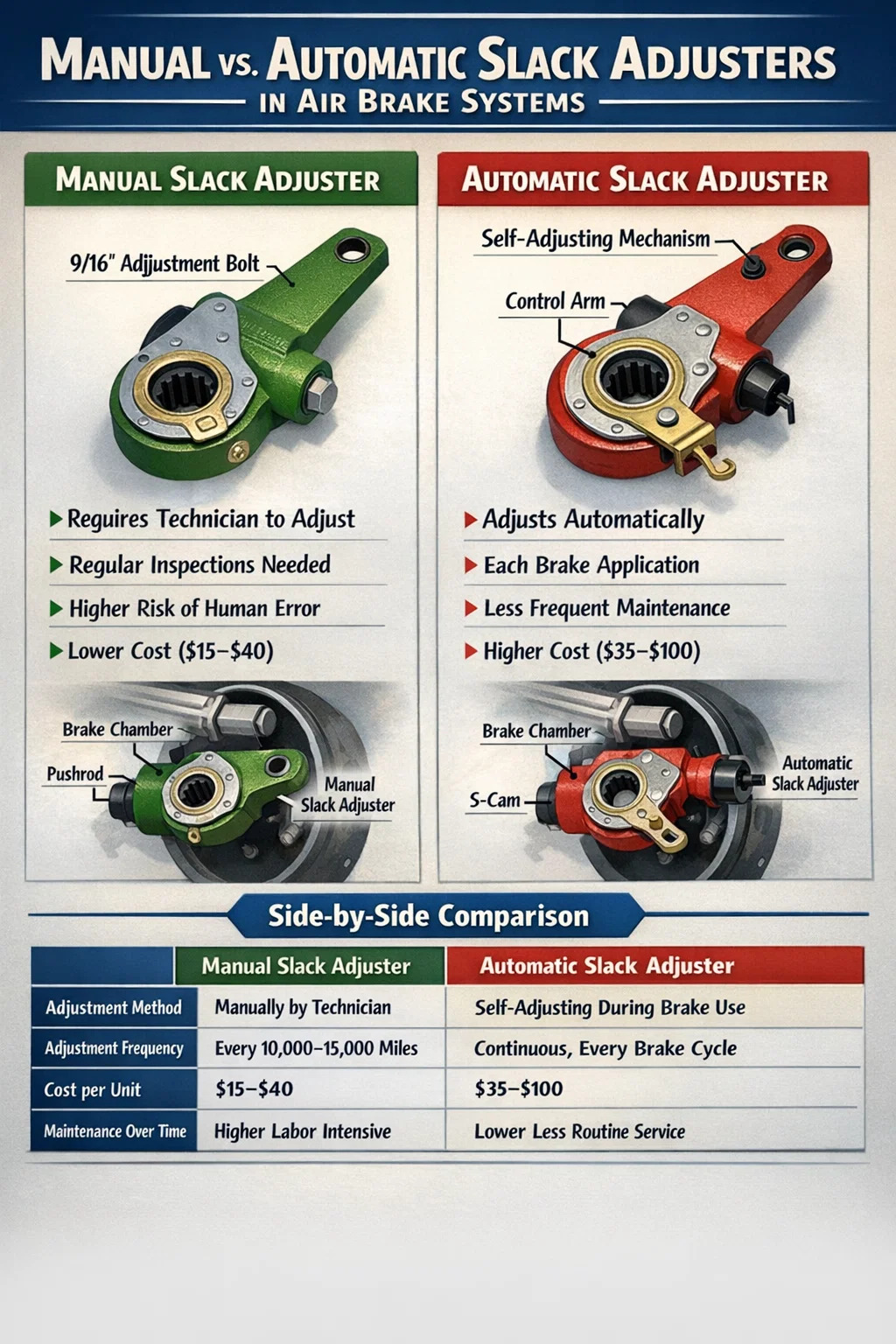
There are two types of slack adjusters: manual slack adjusters and automatic slack adjusters. Both are mechanical devices used in air brake systems on commercial trucks, trailers, and buses to maintain the correct distance—called the pushrod stroke—between the brake chamber and the brake shoes. When that gap grows too large due to lining wear, braking efficiency drops dangerously. Slack adjusters compensate for that wear and keep the system operating within safe limits. The core difference between the two types is simple: manual slack adjusters require a technician to physically adjust them on a scheduled basis, while automatic slack adjusters self-adjust every time the brakes are applied.
Understanding both types matters whether you're a fleet manager, a commercial driver, a brake technician, or someone studying for a CDL. Federal regulations under FMCSA 393.47 set strict limits on pushrod travel, and failing an inspection because of out-of-adjustment brakes can ground a vehicle immediately. Knowing how each type of slack adjuster works—and what can go wrong with each—keeps vehicles compliant, safe, and on the road.
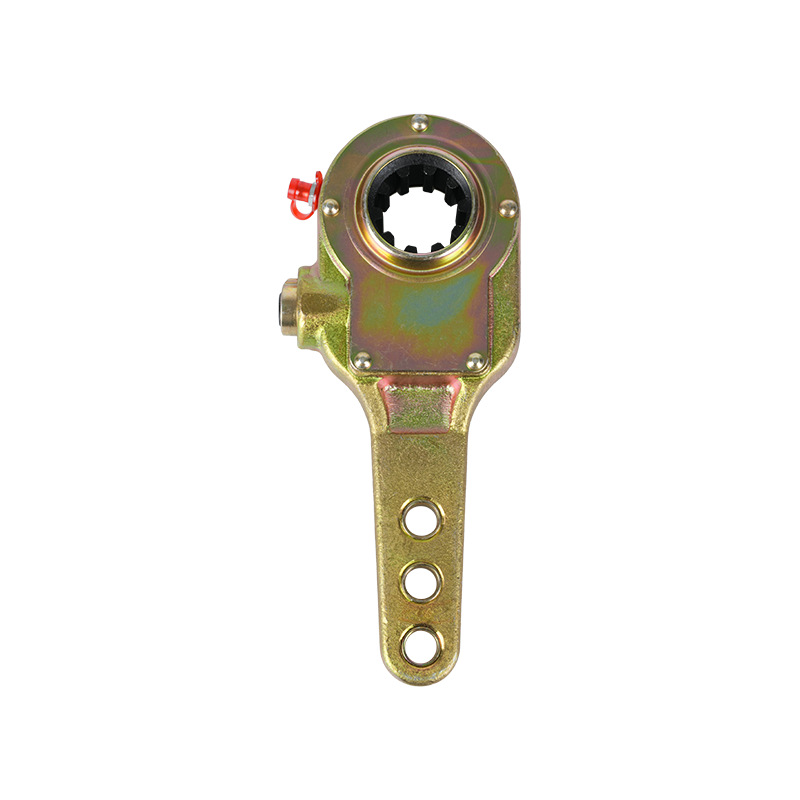
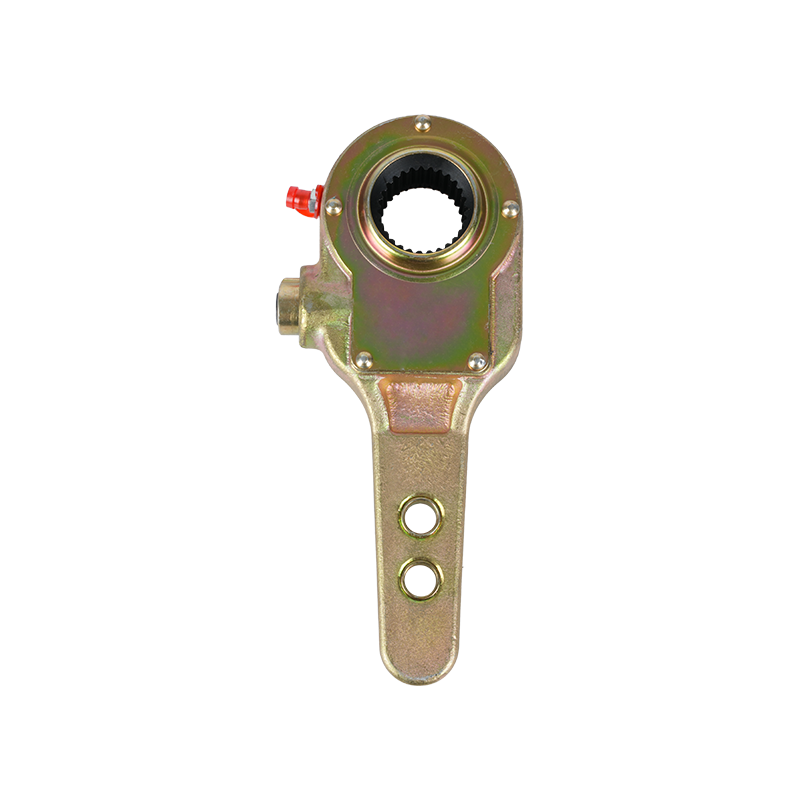
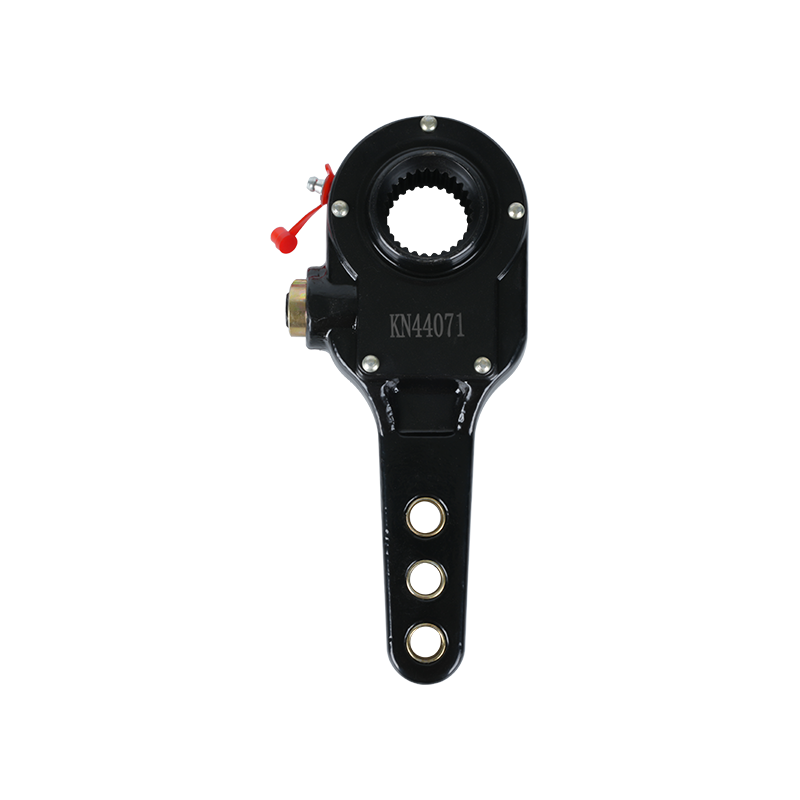
Manual slack adjusters have been a standard component in air brake systems for decades. They are a splined, worm-gear mechanism attached to the brake camshaft. When the brake chamber pushrod extends and pushes the slack adjuster arm, it rotates the S-cam, which forces the brake shoes outward against the drum. Over time, as brake lining material wears down, the pushrod has to travel farther to achieve the same contact. That increased travel reduces braking force and response time.
To correct this, a technician must periodically turn the adjustment bolt—usually a 9/16-inch hex fitting—on the side of the slack adjuster. Turning it clockwise tightens the adjustment, effectively shortening the distance the pushrod needs to travel. The FMCSA specifies that free stroke should be between 1/2 inch and 3/4 inch, and total pushrod stroke at application must not exceed the limits defined by chamber size. For a Type 30 chamber, for instance, the maximum stroke allowed is 2 inches.
Manual slack adjusters typically need to be checked and adjusted every 10,000 to 15,000 miles under normal operating conditions, or more frequently in high-wear environments like construction or mountain driving. Many fleets include manual adjuster checks in every preventive maintenance cycle. The procedure itself takes only a few minutes per wheel end when done correctly, but it requires the vehicle to be safely chocked, the parking brake released, and the technician to measure stroke before and after adjustment with a ruler or tape measure.
One common mistake with manual slack adjusters is over-tightening. If the adjuster is wound too tight, the brakes drag, causing accelerated lining wear, heat buildup, and potential brake fade. Dragging brakes can raise drum temperatures above 500°F, which accelerates lining degradation significantly. Technicians are trained to back off slightly after bringing shoes into contact, creating the proper running clearance.
While most new commercial vehicles in North America have been equipped with automatic slack adjusters since the mid-1990s—largely driven by FMCSA rulemaking that took effect in 1994 for tractors and 1995 for trailers—manual slack adjusters are still found on:
Manual slack adjusters are less expensive upfront—typically ranging from $15 to $40 per unit—which is why they remain common in budget-conscious operations or regions with lower regulatory oversight.
Automatic slack adjusters—also called ASAs or auto slack adjusters—perform the same fundamental job as their manual counterparts, but they include an internal clutch and actuator mechanism that automatically corrects pushrod stroke during normal brake applications. Every time the brakes are fully applied and released, the internal sensing mechanism detects whether the stroke is within acceptable limits. If the stroke is too long, the worm gear rotates slightly to take up the slack.
The most widely used design principle in automatic slack adjusters involves a pawl-and-ratchet or clutch-based system connected to a control arm that senses the angle of rotation during brake application. When the rotation exceeds the preset threshold—indicating that linings have worn and stroke has increased—the internal mechanism advances the worm gear by a fraction of a turn, reducing stroke back to the correct range.
Within the category of automatic slack adjusters, there are two primary design approaches used by manufacturers:
Both designs achieve the same goal but use different internal logic to detect wear. Fleet mechanics often develop preferences based on the vehicle makes they service most frequently, as certain OEM pairings are optimized for specific adjuster designs.
One of the most dangerous myths in commercial vehicle maintenance is that automatic slack adjusters require no attention. This is incorrect and has contributed to serious brake-related accidents. FMCSA data has shown that brake adjustment violations consistently rank among the top out-of-service conditions found during roadside inspections—even on vehicles equipped with automatic adjusters.
If an automatic slack adjuster is found consistently out of adjustment, it is a symptom of an underlying problem, not a calibration issue. Common root causes include:
Technicians are instructed never to manually back-adjust an automatic slack adjuster as a fix for chronic out-of-adjustment conditions. Doing so temporarily masks a mechanical problem that will return and will worsen over time. The correct response is to identify and repair the root cause.
The table below summarizes the key differences between manual and automatic slack adjusters across the most important performance and maintenance categories:
| Feature | Manual Slack Adjuster | Automatic Slack Adjuster |
|---|---|---|
| Adjustment Method | Manual by technician | Self-adjusting during brake use |
| Adjustment Frequency | Every 10,000–15,000 miles | Continuous / each brake cycle |
| Unit Cost (approx.) | $15–$40 | $35–$100 |
| Labor Cost Over Time | Higher (regular adjustments needed) | Lower (less routine service) |
| Risk of Human Error | Higher (depends on technician) | Lower (mechanical automation) |
| Regulatory Requirement (US) | Permitted on pre-1994 vehicles | Required on new vehicles since 1994/1995 |
| Diagnostic Clarity | Straightforward to inspect | Out-of-adjustment signals deeper issues |
| Internal Complexity | Simple worm gear mechanism | Clutch/pawl mechanism added |
To fully understand why slack adjusters matter, it helps to know their exact position in the air brake system. When a driver presses the brake pedal on a vehicle with an S-cam drum brake system, compressed air flows into the brake chamber. Inside the chamber, a diaphragm pushes against a metal plate, which extends the pushrod outward. That pushrod is connected to one end of the slack adjuster arm. As the pushrod extends, it rotates the slack adjuster, which turns the S-cam through a splined shaft. The S-cam pushes the brake shoes outward against the inside of the brake drum.
The slack adjuster effectively acts as a lever between the brake chamber and the camshaft. Its length—typically 5.5 inches or 6.5 inches for standard applications—directly affects the mechanical advantage applied to the cam. A longer arm increases torque but reduces the stroke-to-rotation ratio. Matching the correct slack adjuster length to the chamber size and cam timing is essential for optimal braking performance and is specified in each vehicle's brake specification sheet.
When brakes are fully released and the system is at rest, the slack adjuster arm should be positioned roughly perpendicular to the pushrod—forming close to a 90-degree angle. This geometry maximizes mechanical efficiency when the brakes are applied. If the arm is at a significantly different angle at rest, it indicates either incorrect installation or excessive stroke, both of which reduce braking power. During a pre-trip inspection, a driver can visually identify a severely misaligned slack adjuster, which is one reason CDL training includes brake system inspection fundamentals.
Regardless of which type is installed, slack adjuster inspection is a mandatory part of commercial vehicle safety compliance. Here is a practical overview of the inspection process used by trained brake technicians:
Additionally, technicians will manually push and pull on the slack adjuster arm with brakes released. More than 1 inch of free movement indicates worn camshaft bushings or loose foundation components that will affect adjuster performance regardless of type.
The following are maximum allowable applied strokes for common brake chamber types per FMCSA regulations:
| Chamber Type | Outside Diameter (in) | Max Stroke (in) |
|---|---|---|
| Type 9 | 6.4 | 1.75 |
| Type 12 | 7.1 | 1.75 |
| Type 16 | 7.9 | 1.75 |
| Type 20 | 8.8 | 2.00 |
| Type 24 | 9.5 | 2.00 |
| Type 30 | 10.5 | 2.00 |
| Type 36 | 11.3 | 2.25 |
Both types of slack adjusters can fail, and both types of failures can result in vehicle out-of-service violations or, more critically, brake failure on the road. Recognizing the warning signs early prevents costly breakdowns and keeps vehicles compliant.
When replacing a slack adjuster—whether on a steer axle, drive axle, or trailer—several specification variables must be matched precisely to the existing brake system. Installing a physically compatible-looking adjuster with incorrect internal calibration or arm length can introduce immediate brake imbalance.
Key selection criteria include:
Major slack adjuster manufacturers including Haldex, Bendix, Meritor, and Gunite all publish detailed cross-reference and application guides. Always confirm part numbers against the vehicle's brake specification sheet or OEM documentation before installation.
The industry shift away from manual slack adjusters in the United States was driven primarily by data showing that brake adjustment was one of the leading contributing factors in heavy truck accidents. Studies conducted in the late 1980s and early 1990s found that a significant percentage of trucks inspected at roadside had at least one brake out of adjustment, with improper manual adjuster maintenance being the dominant cause.
The FMCSA's predecessor, the Federal Highway Administration (FHWA), introduced the automatic slack adjuster mandate through 49 CFR Part 393. Trucks manufactured on or after October 20, 1994 must be equipped with automatic slack adjusters on all brake positions. Trailers manufactured on or after October 20, 1995 face the same requirement. This regulation was part of a broader brake safety improvement package that also addressed brake system stopping distance requirements.
Canada followed with similar requirements through Transport Canada regulations, and many other jurisdictions have adopted equivalent standards. The result has been a measurable improvement in brake adjustment compliance rates during roadside inspections, though violations remain common enough that brake adjustment continues to generate a large share of out-of-service orders during operations like the Commercial Vehicle Safety Alliance's (CVSA) annual Roadcheck inspections.
Despite the regulatory push, it's worth noting that automatic slack adjusters do not eliminate the need for brake system inspections—they simply shift the technician's focus from routine adjustment to root-cause investigation and foundation brake component maintenance.
Both manual and automatic slack adjusters require proper lubrication to function correctly and achieve their rated service life. Most modern slack adjusters are equipped with grease fittings and should be greased at every preventive maintenance interval—typically every 25,000 miles or as specified by the manufacturer, whichever comes first.
The correct grease type matters. Most manufacturers specify an NLGI #2 lithium-complex grease rated for high-temperature and water-resistant applications. Using standard chassis grease or mixing grease types can lead to inadequate lubrication at high operating temperatures or accelerated corrosion of internal components.
With proper maintenance, a quality automatic slack adjuster should deliver a service life of 500,000 miles or more on line-haul applications. Vocational applications involving frequent, heavy brake use—such as refuse collection, ready-mix concrete delivery, or dump trucks operating in hilly terrain—typically see shorter service intervals, sometimes requiring replacement at 150,000 to 250,000 miles. Manual slack adjusters, being simpler devices, can often last the life of the brake components they serve, provided the adjustment bolt is never seized.
Contamination from brake dust, road salt, and water is the primary enemy of slack adjuster longevity. Wheel-end areas should be cleaned and inspected whenever brakes are serviced, and grease boots or covers should be checked for cracks that allow contaminants to enter the adjuster body.
Yes, and it is generally a recommended upgrade when maintaining older vehicles. The replacement must use the correct arm length, spline count, and rotation direction for the specific axle. The control arm anchor point for the automatic adjuster must also be installed correctly, as this component is often missing on axles that previously used manual adjusters.
Automatic slack adjusters do have an external hex fitting that can be used for manual adjustment, but this should only be done during initial installation or as a temporary measure to verify system function. Routinely backing off or advancing an automatic adjuster by hand is a sign that something else in the brake system needs repair. It is not a maintenance practice—it is a diagnostic flag.
Air disc brakes, which are becoming increasingly common on steer axles and drive axles in North America, do not use traditional S-cam slack adjusters. They use an integrated adjuster mechanism built into the caliper assembly. However, the regulatory requirement for maintaining proper brake adjustment still applies, and the automatic adjustment function built into the disc brake caliper serves the same purpose as a slack adjuster on a drum brake system.
Installing a slack adjuster with the wrong hand (left instead of right or vice versa) causes the adjuster to pull the cam in the wrong direction when brakes are applied. The result is little to no braking force at that wheel end, and in the case of an automatic adjuster, the self-adjustment mechanism will work in reverse—progressively loosening instead of tightening. This is a serious safety hazard and would be detected immediately during a proper brake stroke check following installation.


 English
 中文简体
中文简体 русский
 عربى
عربى